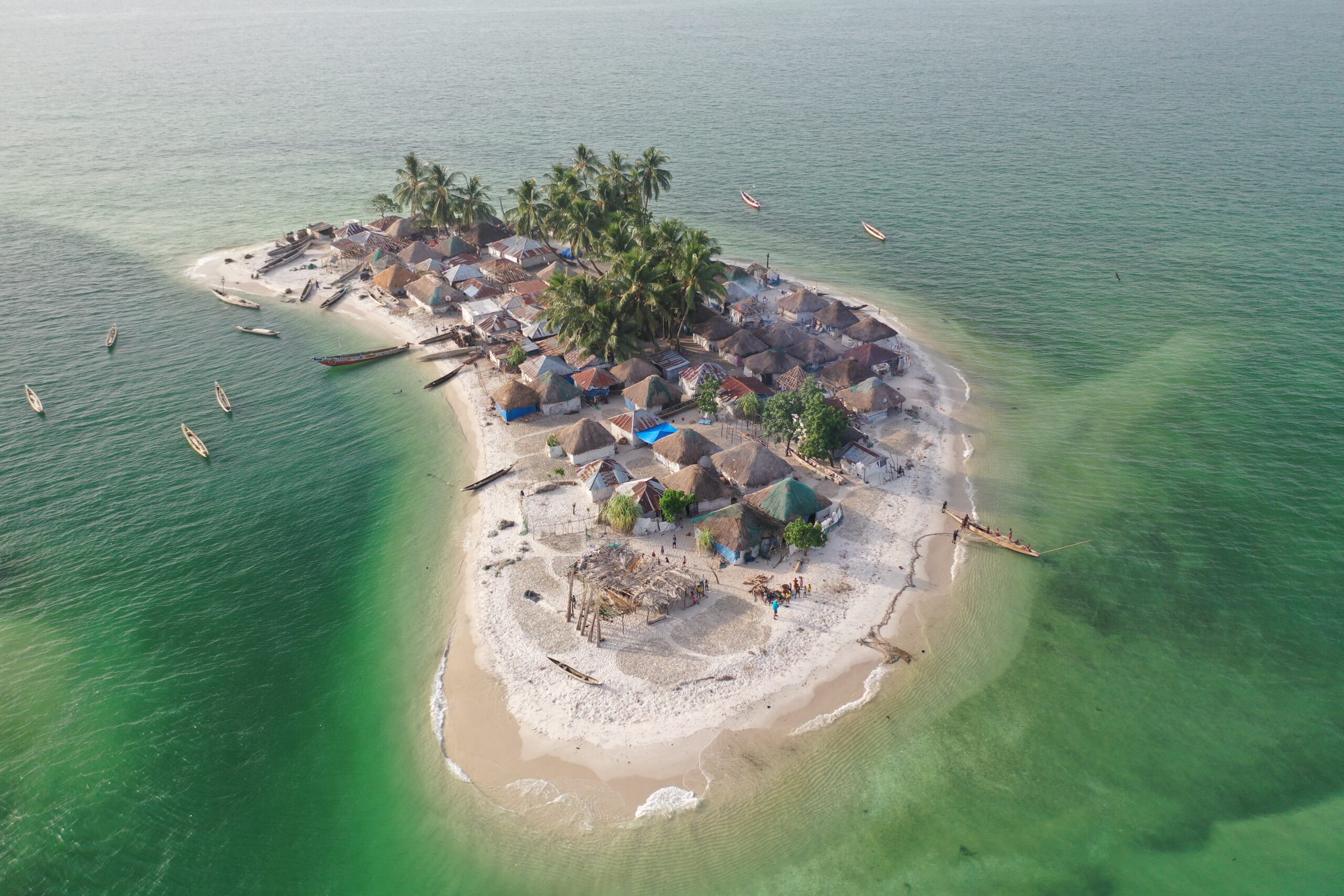
THIS ISLAND
On this Island, the waves lap against the shorelines, the palm trees sway in the breeze, and the sun beats down on the white sand. Children run along the sand, shouting and laughing. They fall, cry, get up and carry on. They plunge their bodies into the ocean to wash away the sand, and then throw themselves straight back into the water again. Radios buzz in the background, Afrobeats, and BBC World Service interrupting the sounds of the island. Arguments erupt over the price of fish, and ‘congo sarr’ amongst the community. The heat can be felt in the air.
Cockerels crow. Sheep bleat. Insects fill the air. Fish smoke over fires. The waves continue to lap against the shore.
This is home.
But the island is disappearing.
Some people have moved their homes five times to retreat from the disappearing ground.
Tommy Nyuma told us that many years ago, ‘white scientists came to the island and warned us that it would soon be underwater. But women have had children, those children have grown and had children of their own, and still the island remains.’ But now, after his third home was flooded by the water, he left the island to make his home elsewhere.
The government, and the Paramount Chief have told them that they must leave, that it is no longer safe to remain in their homes.
The island is being eaten by the water.
This work remembers the island.
The Island is called Nyangai (sometimes spelt Nyankei or Nyangei) It is part of the Turtle Islands archipelago and is situated off the coast of Sierra Leone, West Africa.
...time taken to travel by boat
The island is 50km off the coast of Sierra Leone, West Africa.
It takes around twenty fours to reach the island in a passenger boat from the mainland.
Beyond the archipelago there is nothing but the vast Atlantic Ocean
...year of the first appearance on a map
People are believed to have migrated to this region of West Africa centuries and centuries ago. The island, and wider archipelago, was first documented on a map in 1834.
...is the estimated number of people currently living on the island in around 70 homes.
The population has diminished to perhaps 5% of the number of inhabitants when the island was at its most populated.
It reduced from an estimated 600 in 2011, to an estimated 230 in 2022, mostly as fears of flooding increased.
...of land lost over the past decade
The vast majority of the islanders have moved their homes across the island at least once
The resident teacher has moved his home four times now
The land has reduced by approximately 93% over the last ten years, and began eroding long before then
THE WORK
The World That Was The Island That Was The World is an ongoing body of work documenting the lives of a community whose home is a disappearing island off the coast of Sierra Leone.
As Sallieu, who was born on the island said: “You’re making a history for us.”
This is an archive of people’s lives unfolding in a place that is disappearing.
The archive spans oral testimony, film, photography, and writing amassed through more than fifteen years of returning to the island. Each work initiated from the archive serves as an act of remembrance of the ways in which the island has changed, what has been lost, and what remains.
With thanks
These works would not have been possible without the incredible trust, support and generosity of all of those people living on Nyangai. Heartfelt thanks to all of you.
Many other people have been crucial in the production of this work. Too many to name individually here.
Special thanks to:
Unisa Kamara, Abdul Brima, Julien Kottukapally, Nathan Hardisty, Kate E Williamson, Morrison Jusu, Khalid Shamis, John Jencks, David Biandoma, Fid Thompson, Tom Sabbadini, Morrison Jusu, Charly Cox, Erika Perez Leon, Chloe Hardwick, David Wigram, James, Kevin, Peter Dale, Nurri Kim